

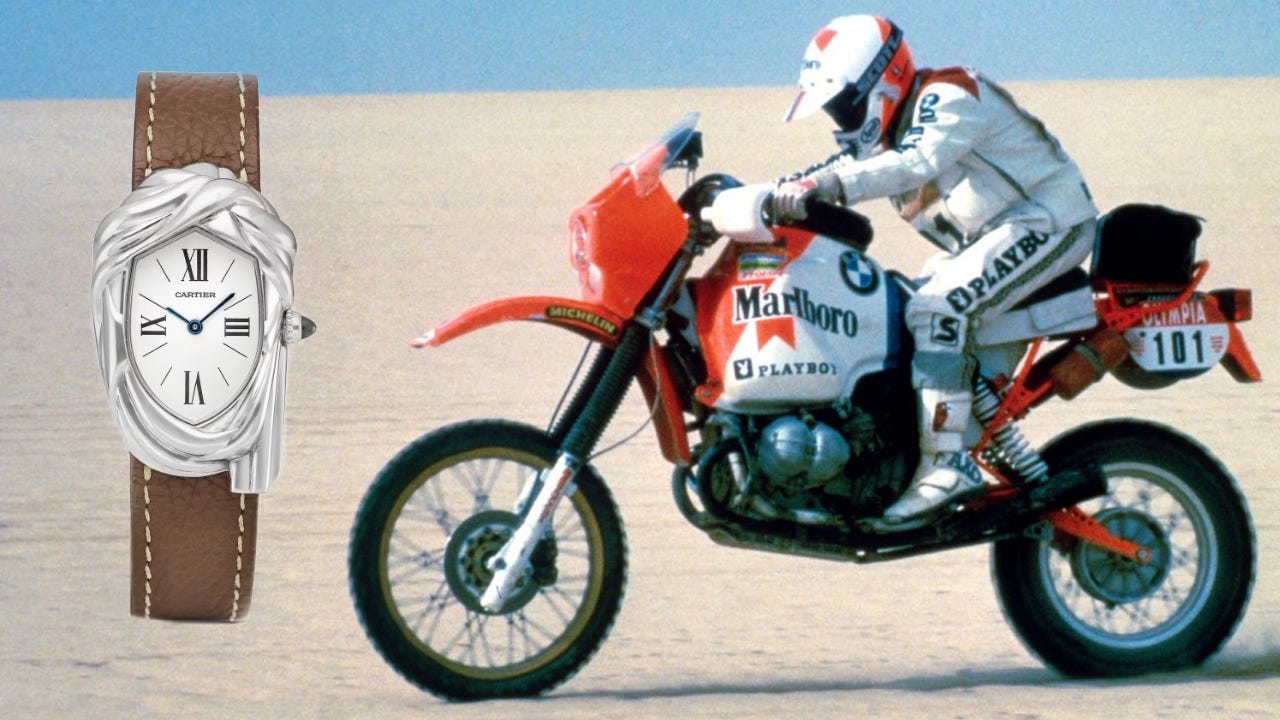
I wasn’t planning to write about the Cartier Cheich this week, but then Sotheby’s auction happened, so that left me with no choice. Last week the Cartier Cheich became the most expensive Cartier ever sold, crushing the record breaking $1.99 Million sale of the Cartier London Crash earlier this year at the Sotheby’s “Shapes of Cartier” auction. This time it fell to a lesser-known watch with arguably an even bolder design. So you can imagine, I found myself back down the same rabbit hole I fall into every time I discover a new oddball vintage Cartier shape.
Everyone who knows Cartier is familiar with the Crash. But I don’t think that’s the case with the Cheich. And that’s exactly the point: only five were ever made. I’ve spent the past few days reading everything I could find on it, and the more I learn, the more it feels like the strangest, most quietly important watch Cartier has ever produced. So a perfect entry for this week’s Collector’s Catalog.
A Trophy Born From the Desert
The story of the Cartier Cheich begins in 1983, when Thierry Sabine (the man behind the Paris-Dakar rally) teamed up with Cartier’s then-president Alain-Dominique Perrin to create the “Cartier Challenge”. This was a prize for any driver who could win the same category of the desert rally for two consecutive years. The Dakar Rally began in 1978 as a brutal off-road race from Paris to Dakar. Competitors crossed dunes, rocks, and open desert, sometimes covering 800 kilometres in a single day. Exhaustion, navigation errors, and mechanical failure were part of the challenge and this was the world Cartier built a trophy for. The challenge almost sounds like a dare.


Sculpted From the Tagelmust
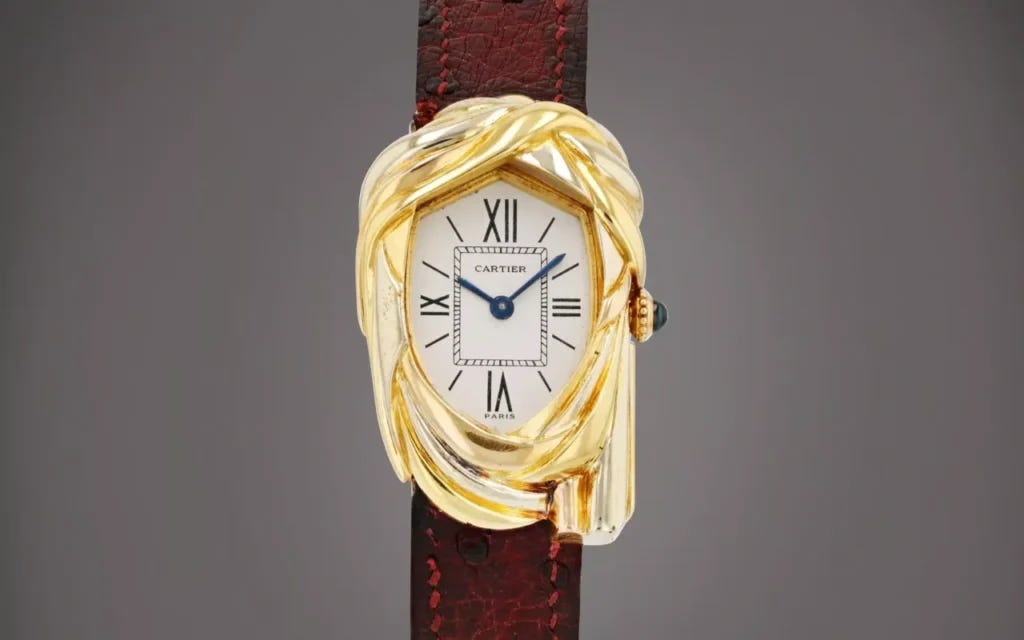
Cartier’s then-creative director Jacques Diltoer took a rather different approach for this piece. His design took inspiration from the Paris-Dakar logo itself: a stylised Tuareg figure wearing the tagelmust, the long cotton headscarf desert nomads wrap around the face for protection from sun and sand. The result is an asymmetrical case with no straight edges — a layered blend of yellow, pink, and white gold whose curves echo both the folds of the cloth and the shape of a dune. The dial keeps things comparatively restrained: a rectangular chemin de fer minute track and Cartier’s signature blue cabochon crown. Under the case sits a manual-wind Frédéric Piguet caliber FE 664. Every example ran on this manual caliber, except for one — a piece made decades later that swapped in a quartz movement, and the one that sold last week.
Gaston Rahier, the Only Winner
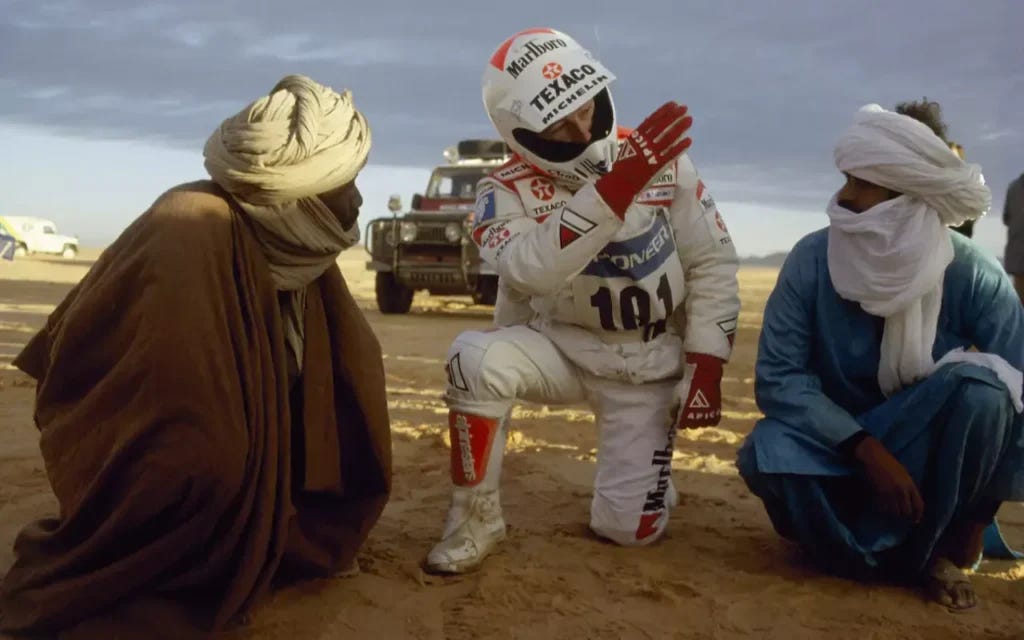
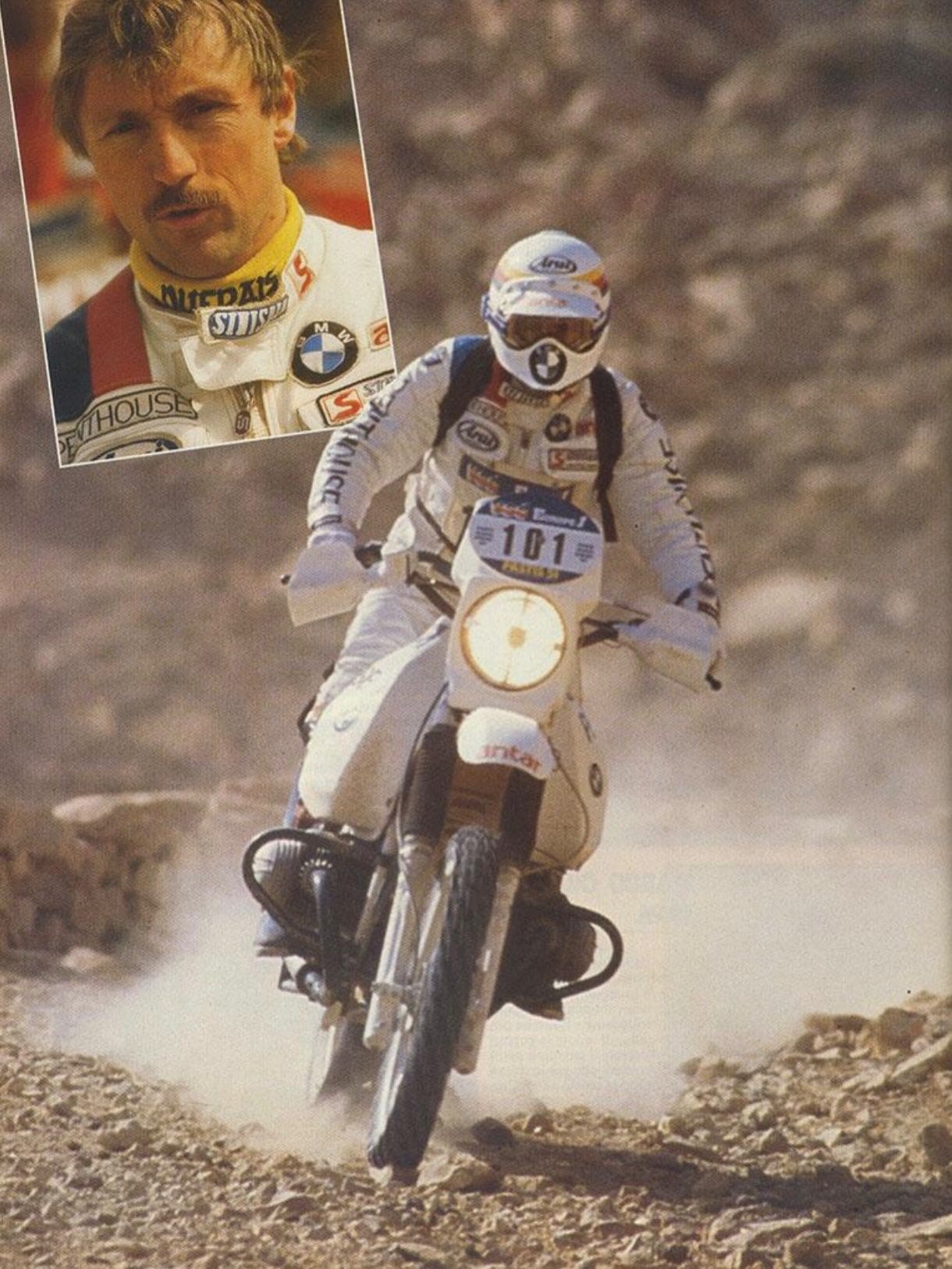
Only one person ever completed the Cartier Challenge: Belgian motocross racer Gaston Rahier, who won the motorcycle category of the Paris-Dakar in both 1984 and 1985 aboard a BMW. The watch was handed over to him personally by Alain-Dominique Perrin. Rahier kept it out of public view for the rest of his life, and it stayed with his family for over thirty years after his death. It wasn’t until Sotheby’s brought it to auction in September 2022 — where it sold for a record $1.1 million. It was the first and, for a long time, only Cartier Cheich ever to reach the open market.


The Fifth Cheich: Giorgio Seragnoli’s White Gold Unicum
Well the story didn’t end there. No, because Cartier decided to quietly produced a fifth Cheich in 2010. This time entirely in white gold, with a quartz movement instead of the original manual caliber. It was made for an Italian collector Giorgio Seragnoli, co-author of the celebrated Cartier Bianco book and, at the time, one of the most serious collectors of white-metal Cartier in the world. The caseback reads “No. 1” — and Cartier has never made a No. 2. That watch came to Sotheby’s Hong Kong last week for its first-ever public sale, hammering at HK$26.51 Million ($3.41 million).
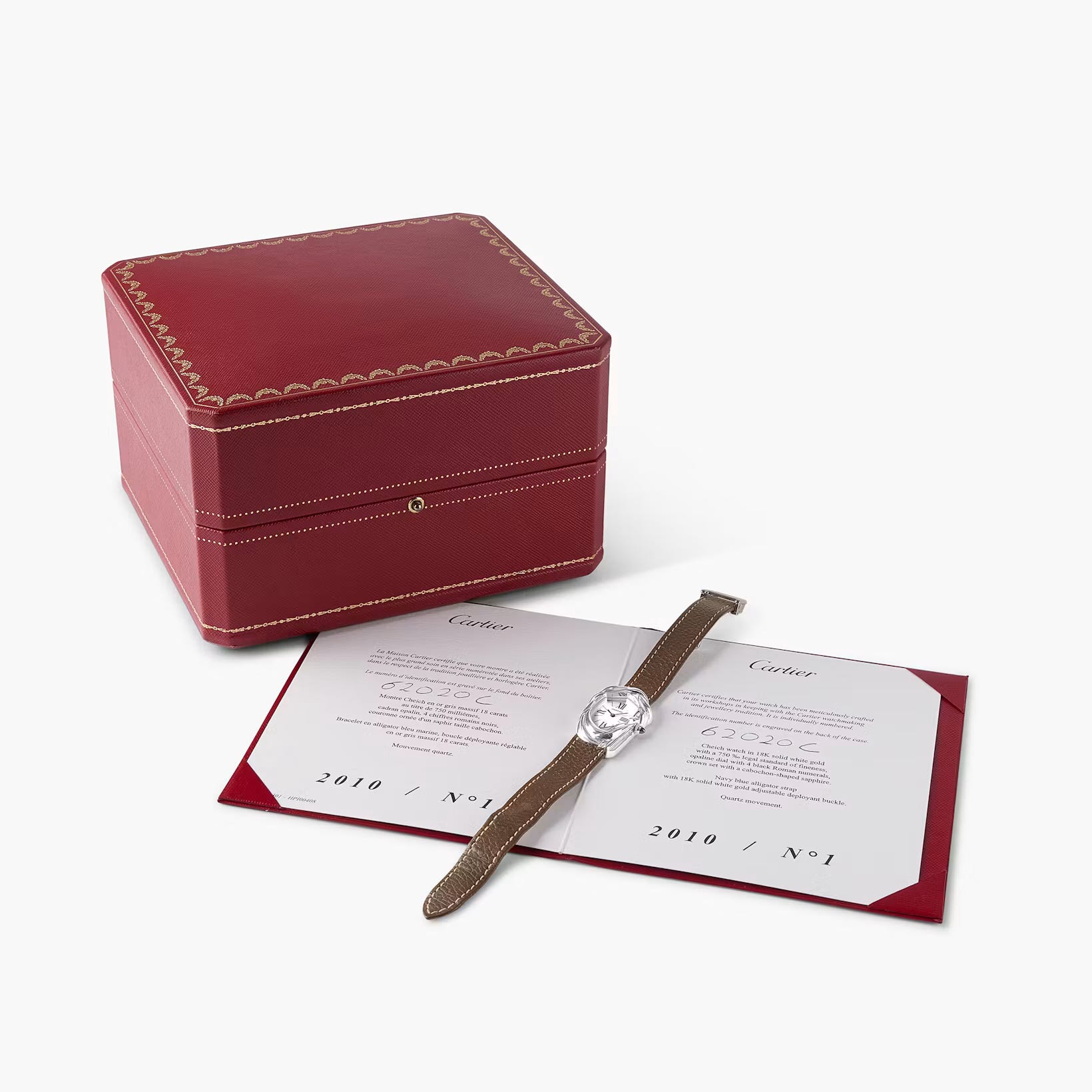


I don’t own a Cartier, and for most collectors the Cheich is a piece that will never be in reach. But if I’m honest, this is the kind of watch that belongs in this catalog: bold design with real history behind it. A watch that was never designed to be bought, only earned. Or in this one particular case, specially commissioned decades after the fact. Though I’ll admit — that last part is something worth discussing. The piece that just sold is the 2010 one, not an original. Does a replica carry the same weight as the four that actually crossed the desert, or is some of that record price just good storytelling? I’ll let you decide. Either way, the Cheich isn’t the most beautiful Cartier ever made, but it might be the one with the most to say. If you ever find yourself with one on your wrist, you’re not just wearing a watch, you’re holding onto a fragment of racing history.