

Ask me which brand a new collector should start with, and Girard-Perregaux probably won’t be my first answer. Not because it doesn’t deserve to be. It just isn’t the name that comes to mind first. And honestly, I think that says more about us than about the brand.
The history is all there. More than two centuries of watchmaking in La Chaux-de-Fonds. The Laureato, which stood its ground among the great steel sports watches of the seventies. The three bridges, a design you recognize as GP before you even see the logo.
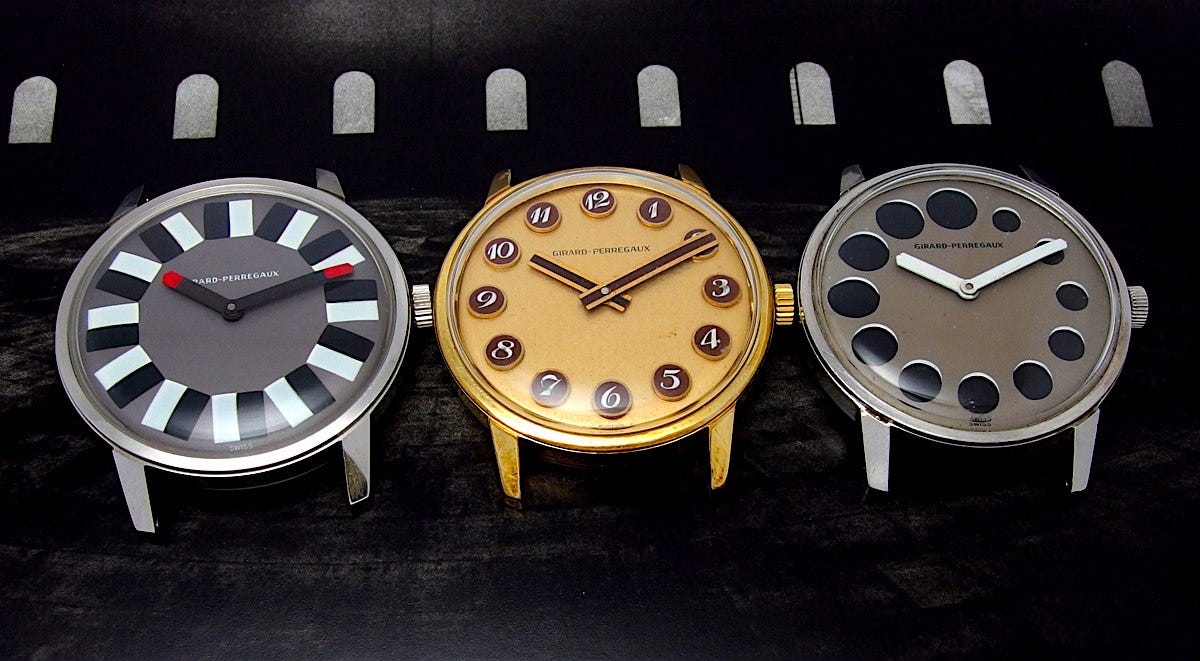
Still, almost nobody talks about the Girard-Perregaux 9034. On paper it’s simple. A plain steel case, a manual movement, nothing that would make you stop scrolling. But that isn’t the point of this watch. The point is the dial. Or rather the dials, because hardly any two of them are the same.
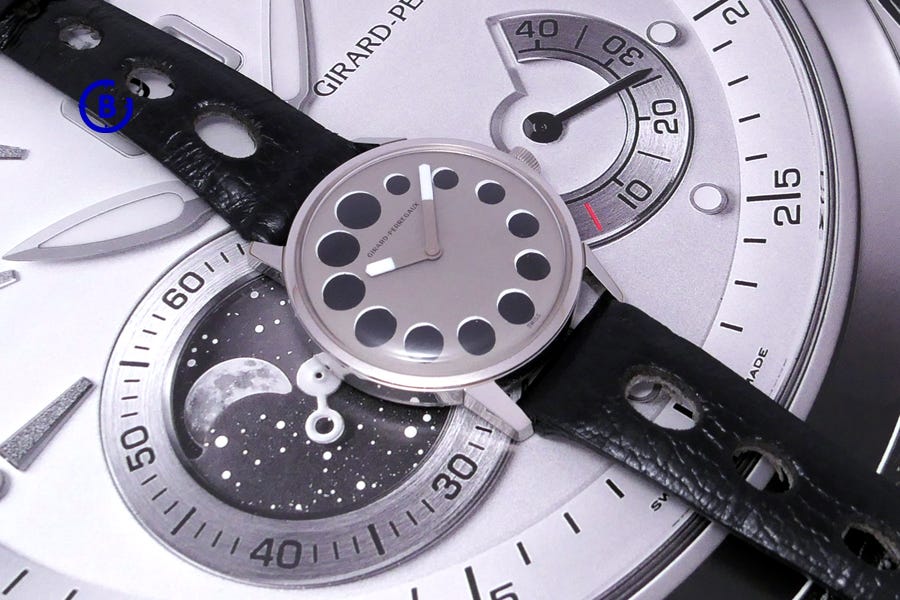
A Moon Watch, two years before the Moon
Girard-Perregaux introduced reference 9034 in 1967 and kept it in production until 1976. The foundation is modest: a 34.5 mm case in stainless steel, with gold-plated versions offered alongside, and the hand-wound calibre GP 12.3. That movement is built on the AS 1640 ébauche, a sturdy and widely used base. This was a watch made to be worn every day, not locked away. Collector and blogger Blomman puts total output at around 13,800 pieces, a number that covers every dial variant rather than only the painted ones.
The marketing is where it gets interesting. In its 1969/70 catalogue, GP presented the 9034 as its “Moon Watch,” mentioned that Playboy magazine had selected it, and sold it on a Corfam sport strap with a choice of dials. That catalogue name is also the strongest evidence in a debate collectors still have: were the painted dots meant as moon phases? The factory’s own wording says yes. A frozen lunar cycle on the dial, two years before Apollo 11.
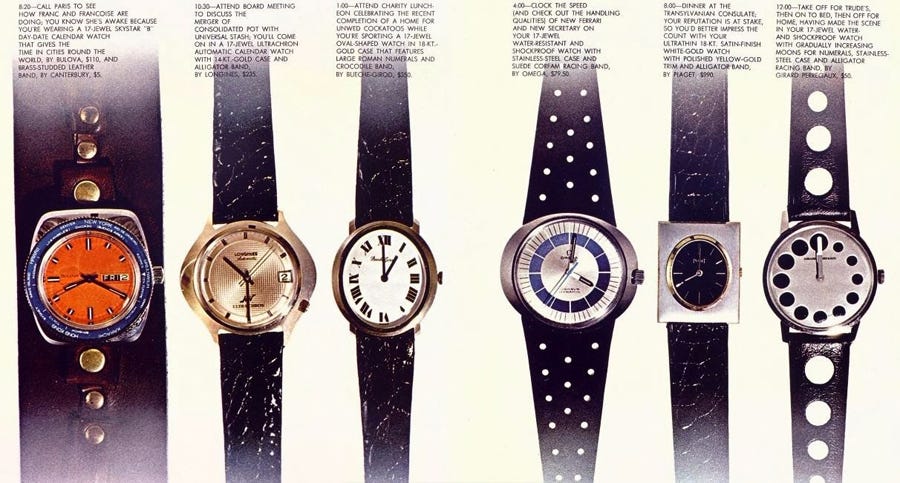
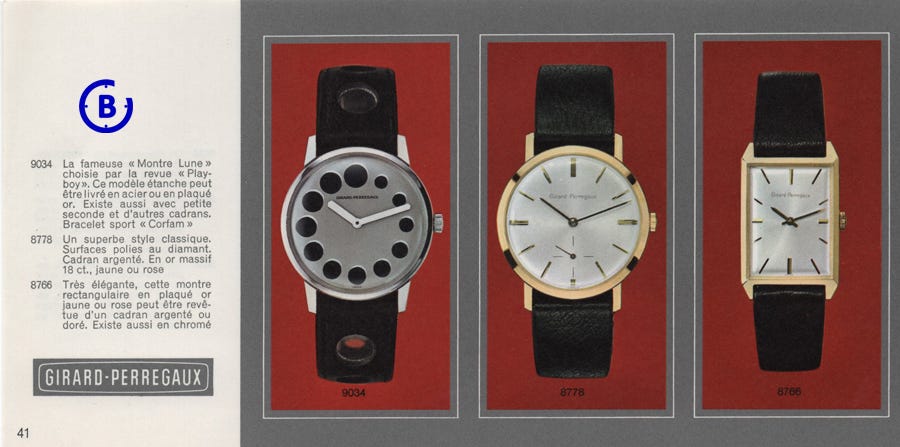
9034 The famous “Moon Watch”, chosen by the magazine “Playboy”.
Waterproof model. Different kinds of dials. Sport bracelet “Corfam”. Steel or gold plated.
Four dials worth knowing
Every painted dial was done by hand, so each one carries small differences in shading and finish.
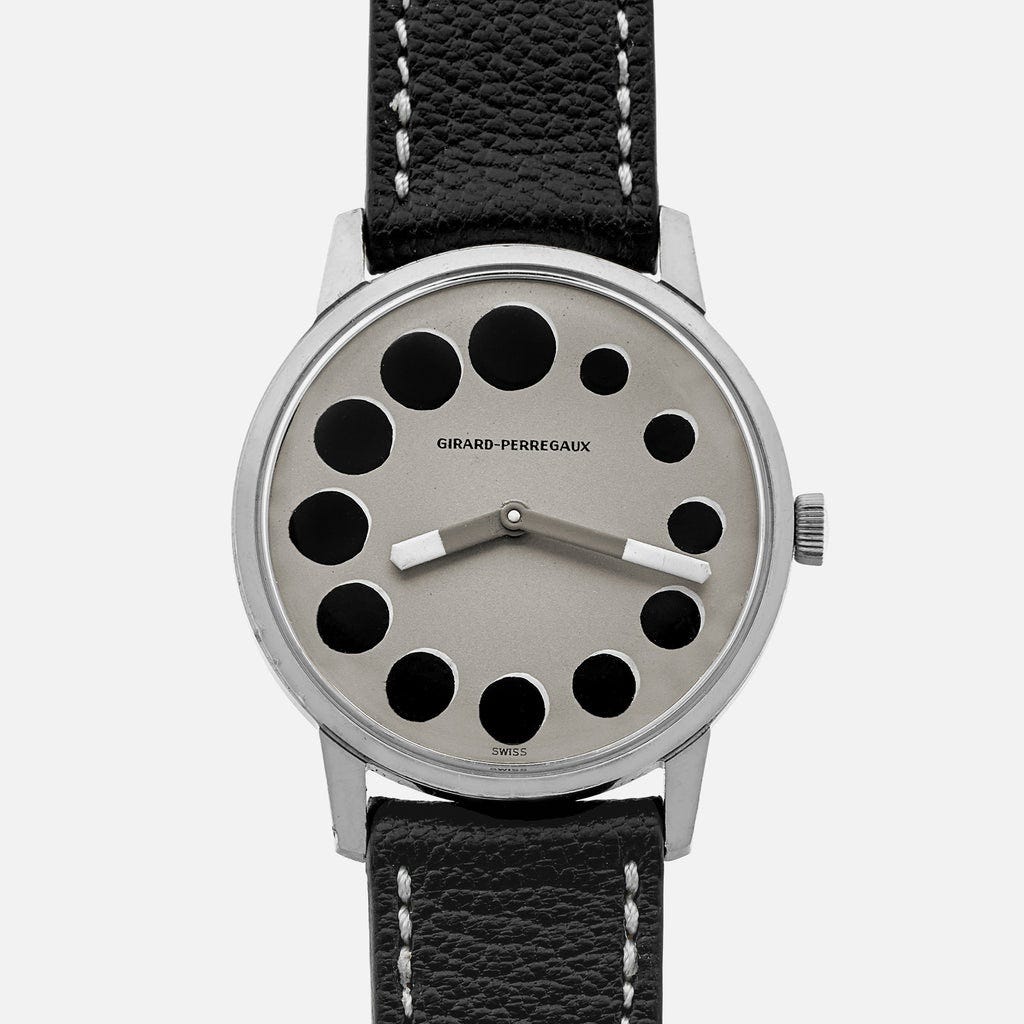
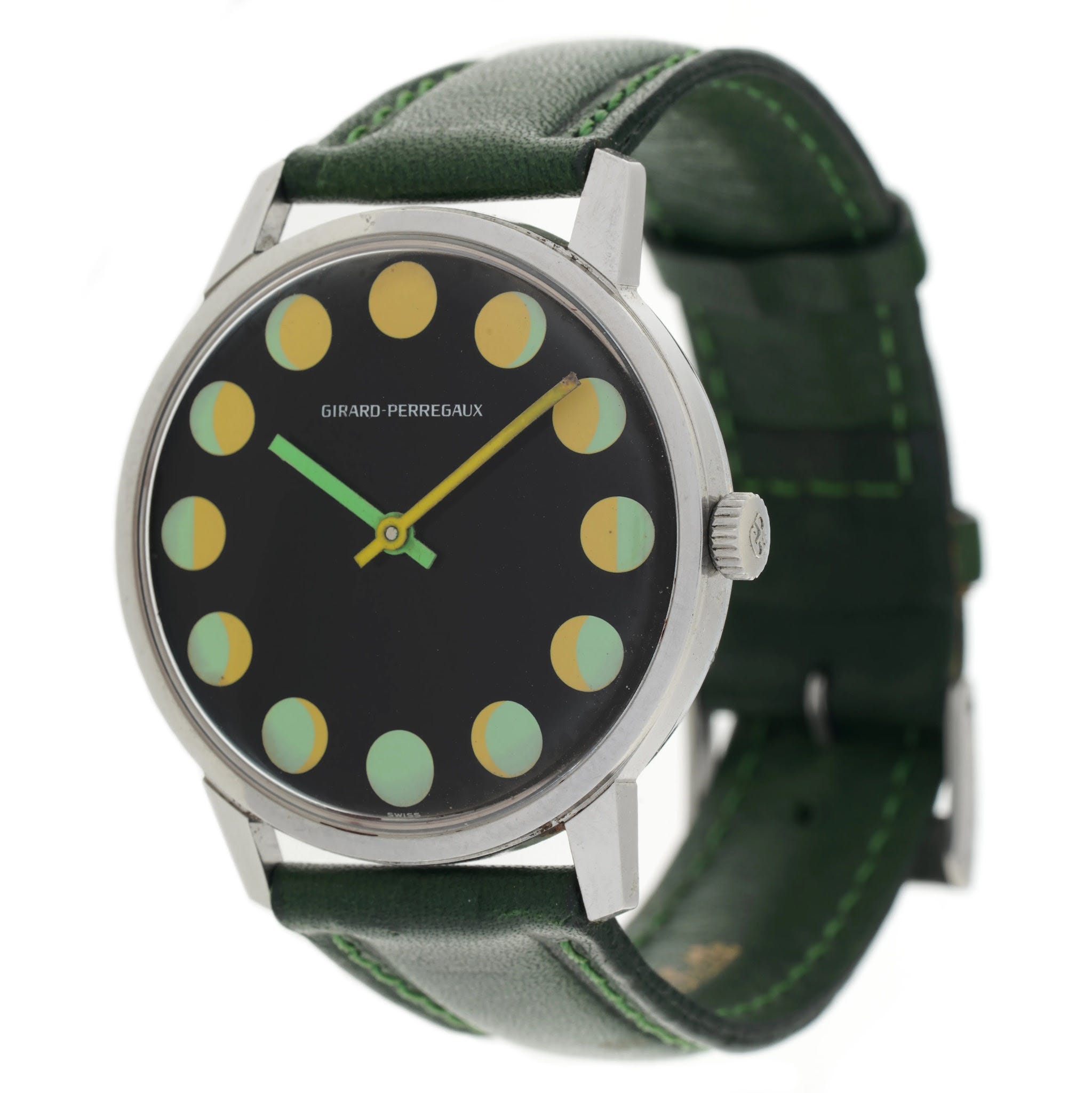
The Circle Dial. The best-known version, and the one that turns up for sale most often. A grey base carries round indexes that grow from smallest at one o’clock to largest at twelve, each with a white crescent of shadow that gives it depth. Hands come fully white or with only white tips. There is no seconds hand; GP chose not to use the small seconds the movement could offer.
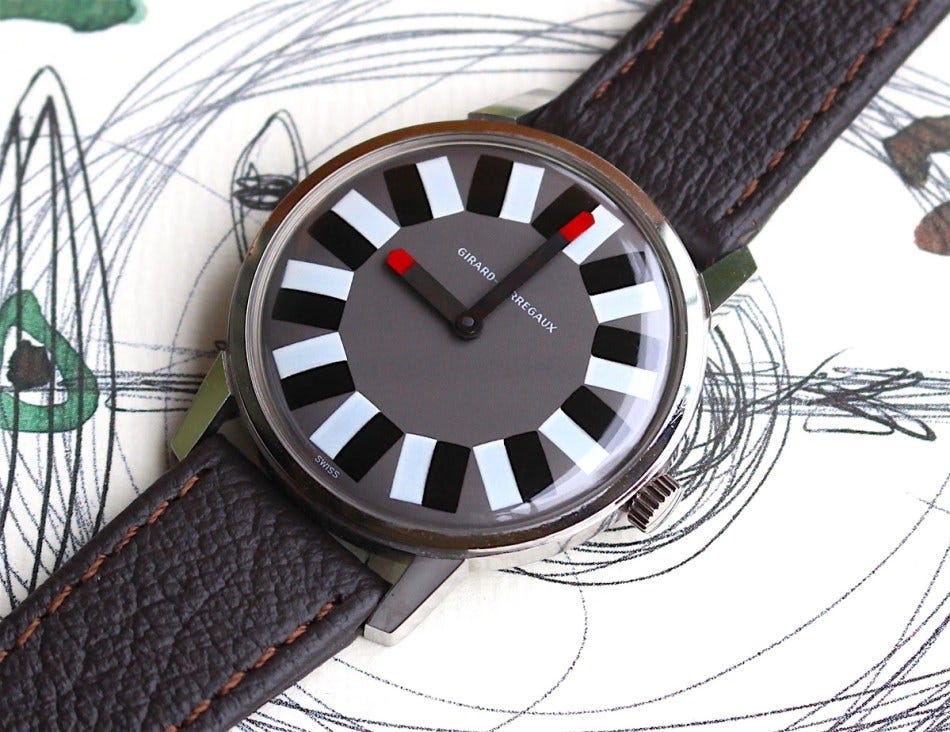
The Flags Dial. Same idea, but rectangles replace the circles, with each marker split between two colors. It’s the rarest of the painted versions. The GP Chronicles collector who owns one suspects a Bauhaus influence, which is plausible given La Chaux-de-Fonds’ design heritage, but remains his theory rather than documented history.
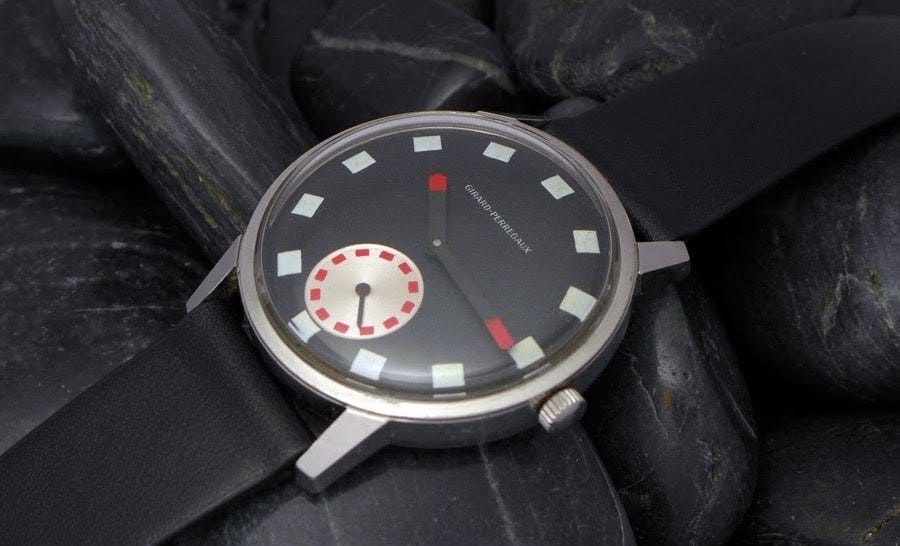
The Casino Dial. The one that breaks the pattern. A dark greyish-blue dial, close to black, with white hour markers, red-tipped hands, and a small seconds subdial, the only one among the painted dials to have it. The name isn’t from the factory: collectors put it to a vote, and the roulette-wheel look won.
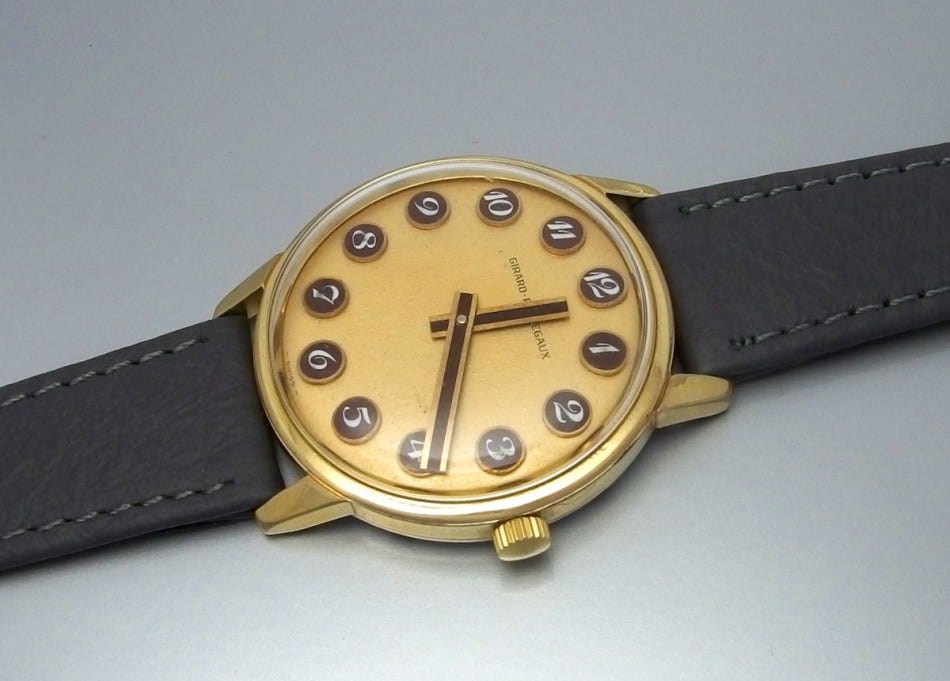
Funky Numerals. A separate family under the same reference, built around applied circular numerals on a brushed dial, with broad hands in matching colors. Known combinations include a gold dial with brown circles, green circles on gold, and blue circles on a silver-toned dial. How many versions exist in total, nobody seems to know.
What a 9034 costs today
Entry prices sat at around €2,000 in early 2025, climbing for the more distinctive dials. For reference, a new-old-stock gold-plated example from 1973, with blue crescents on a gold dial, has been listed by a Dutch dealer at €3,500.
For me, it’s the Circle Dial. Every circle a different size, every shadow just a little off from the next, and together they almost read as a moon phase. The one that really got me is a neon green and yellow version. Just stunning.
That’s why the 9034 goes in my catalog. It’s unique in the most literal sense, since no two dials are exactly alike. And at the $3,000 to $5,000 I’d budget for a good one, I think it’s great value for money.
So tell me: which dial would you pick?