
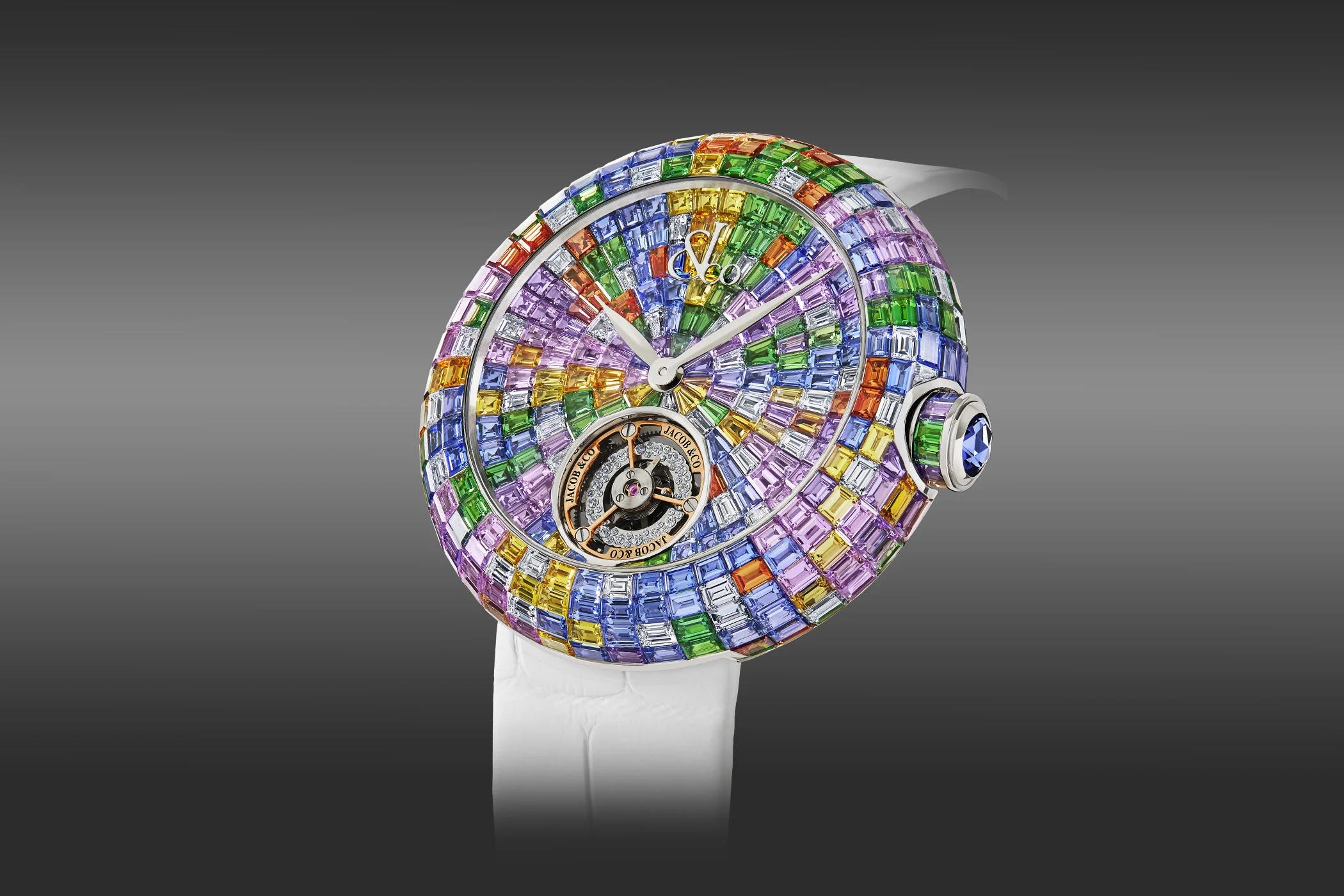
There’s a reason gem-setters have spent two centuries avoiding the balance wheel. It’s the one component in a mechanical watch that can’t afford a single extra milligram, let alone fifty-four diamonds. Jacob & Co. set them there anyway. The result is the Brilliant Flying Tourbillon Baguette Pastel Arlequino, a pièce unique that turns the most sensitive part of a movement into its most dazzling one — without asking the watch to give up a second of accuracy.
Why the Balance Wheel Was Off-Limits
To understand why this matters, you have to understand what the balance wheel actually does. Paired with the hairspring, it forms the regulating organ — the part that governs how fast or slow a watch runs. Its mass, its moment of inertia, its poise: all calculated to tolerances so fine that adding anything to its surface risks throwing off the rate entirely. Watchmakers in the 1820s and 1830s did experiment with diamond-set balance wheels, but those movements ran on cylinder escapements, where losing several minutes a day was simply the cost of doing business. Once chronometric standards tightened, the balance wheel became sacred ground. Gem-setters moved on to bridges, rotors, and case flanks instead. The wheel itself stayed bare — until now.
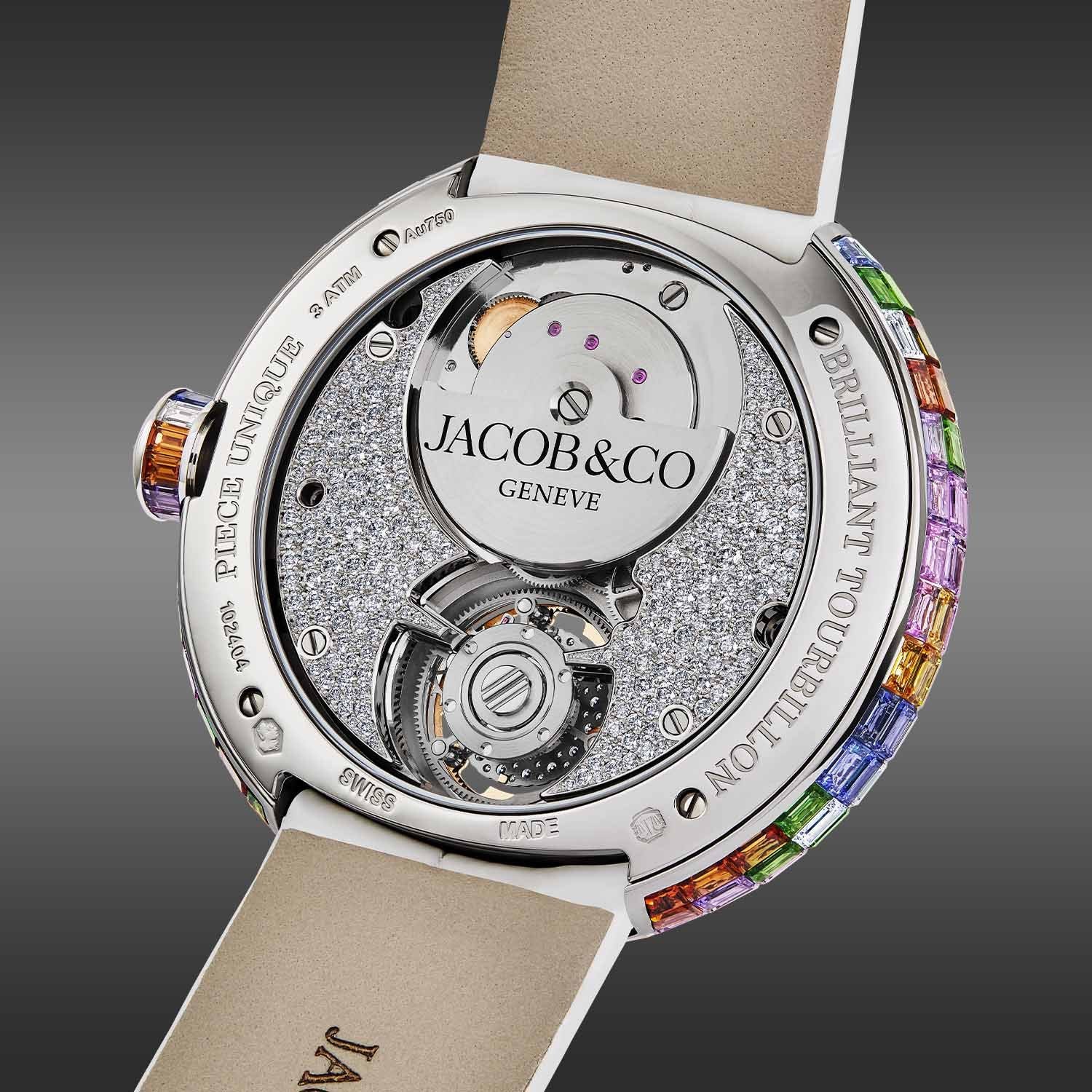
Jacob & Co.’s solution required the movement to be engineered around the diamonds from the start, not the other way around. Fifty-four brilliant-cut white diamonds now sit directly on the balance wheel of the new JCFA02 caliber, a self-winding movement built with a flying tourbillon and micro-rotor, beating at 21,600 vibrations per hour and delivering a 72-hour power reserve. The visual payoff is genuinely unusual: as the balance wheel oscillates at 3 Hz and the flying tourbillon completes its rotation once every sixty seconds, the two motions overlap, catching light from constantly shifting angles. The effect reads less like a watch component and more like a halo that refuses to sit still.
A Case Built on Contrast, Not Harmony
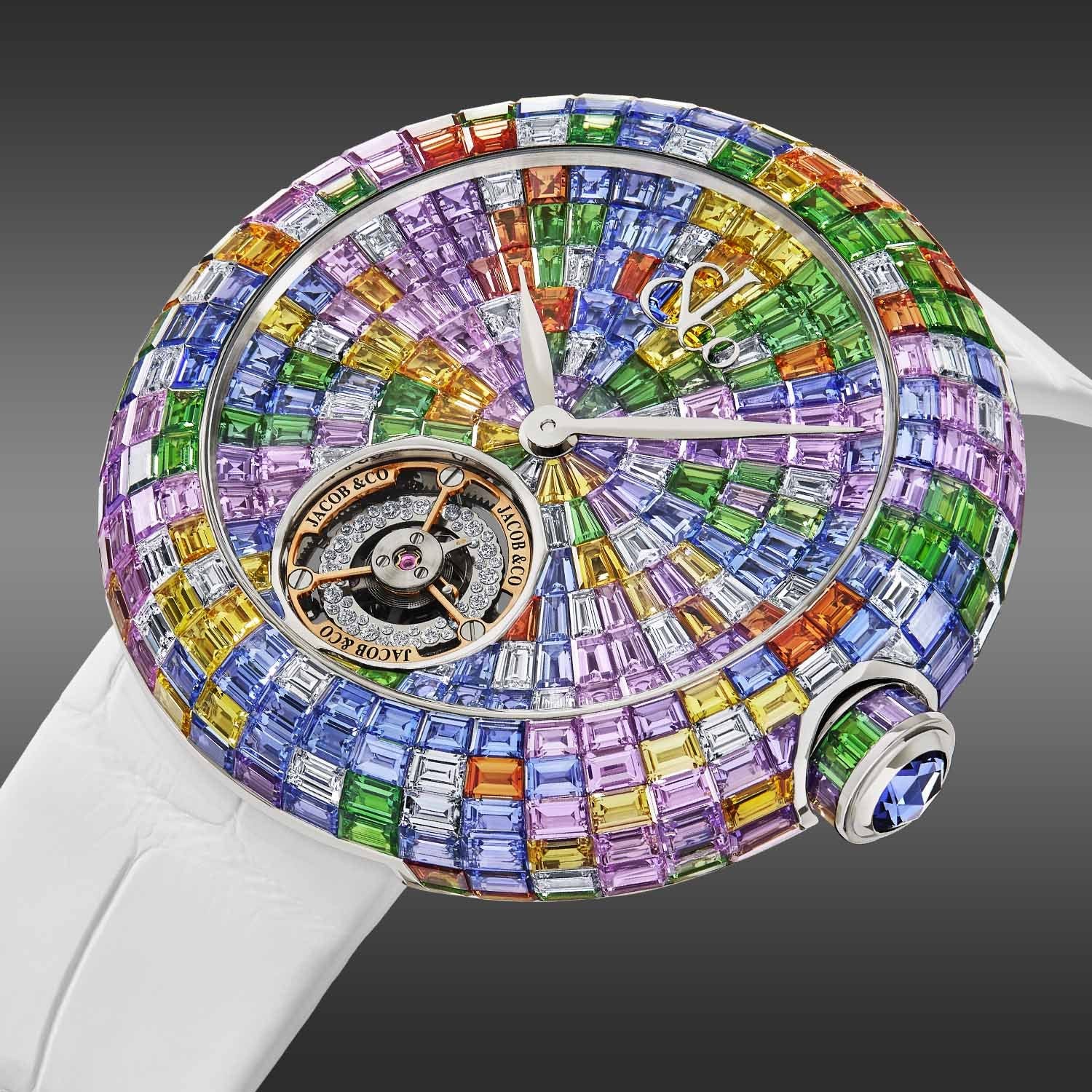
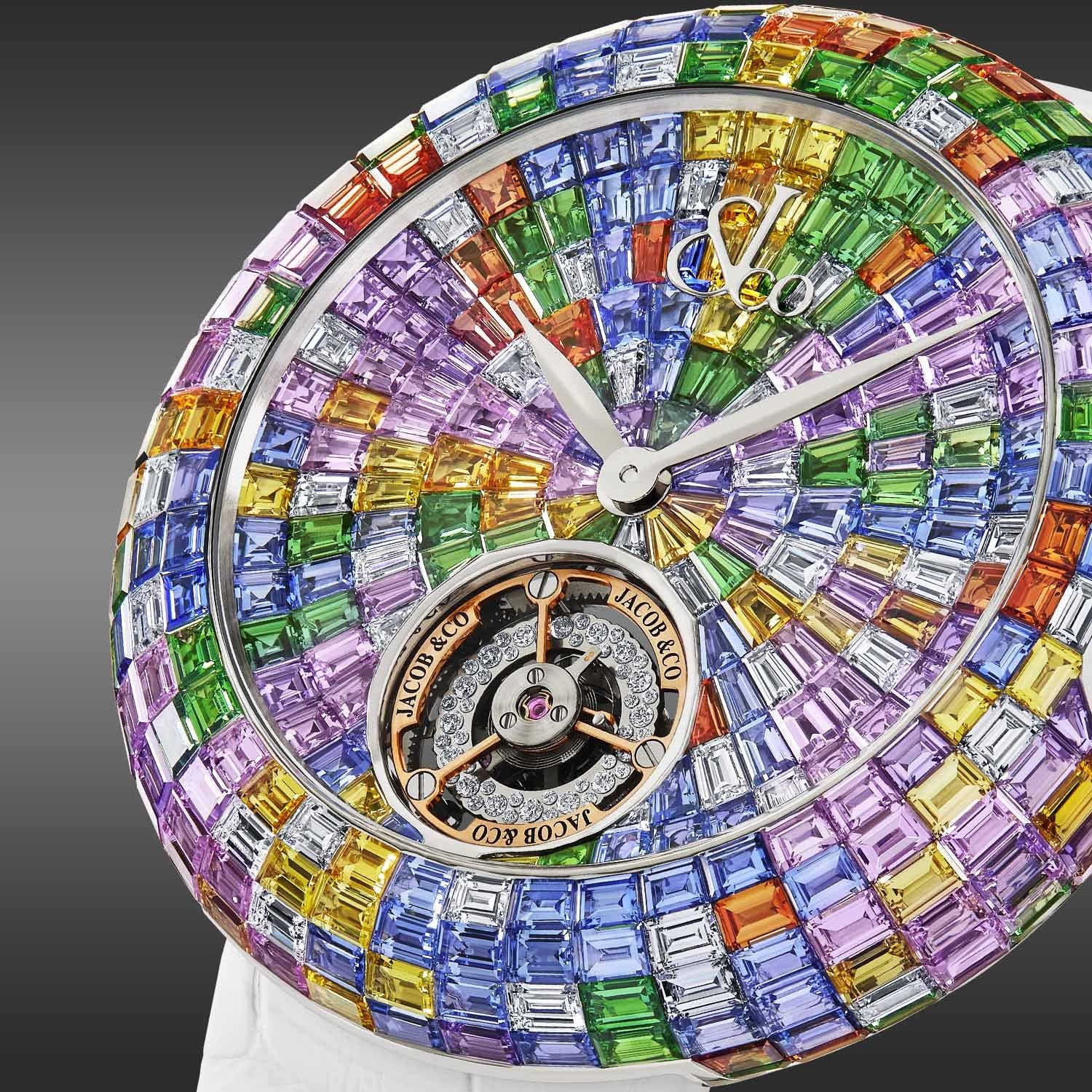
If the movement is the technical headline, the case is the aesthetic one. Jacob & Co. calls the color story Arlequino — a nod to Arlecchino, the commedia dell’arte character whose costume is built from mismatched colored lozenges. The reference isn’t decorative flourish; it’s the literal design brief. Rather than blending gemstones from one hue into the next, the Pastel Arlequino deliberately clashes them: green beside blue, lavender beside pink, no two neighbors alike. What holds the composition together is tone, not color — all 366 sapphires used across the case, dial, crown, and buckle were matched to the same soft, pastel lightness, so a pattern built on contrast still reads as a single, cohesive surface.
Every stone is invisibly set, held from beneath with no visible prong or metal bead breaking the surface. In the 42mm 18K white gold case, that’s 194 baguette-cut sapphires and 32 baguette-cut white diamonds, plus 12 sapphires and a single diamond on the crown. The dial carries another 139 baguette-cut sapphires and 23 white diamonds, and the alligator strap closes with an 18K white gold tang buckle set with 21 more baguette-cut sapphires. Flip the watch over, and the sapphire crystal caseback reveals 234 additional brilliant-cut diamonds on the bridges — a quieter echo of the spectacle happening on the dial side.
What This Means for High Watchmaking
Jacob & Co. built its identity on the phrase “Inspired by the Impossible,” and the Brilliant Flying Tourbillon Baguette Pastel Arlequino is that philosophy taken literally rather than metaphorically. It’s not just a jewelry flex — it’s a functional argument that gem-setting and chronometric precision no longer have to be opposing disciplines. For a maison already known for pushing complications to their limit, reviving a 200-year-old technique and making it work signals where the rest of high jewelry watchmaking may be headed: toward regulating organs as canvases, not just untouchable mechanisms hidden under a bridge. As a pièce unique, this particular watch will only ever exist once. The idea behind it almost certainly won’t.