
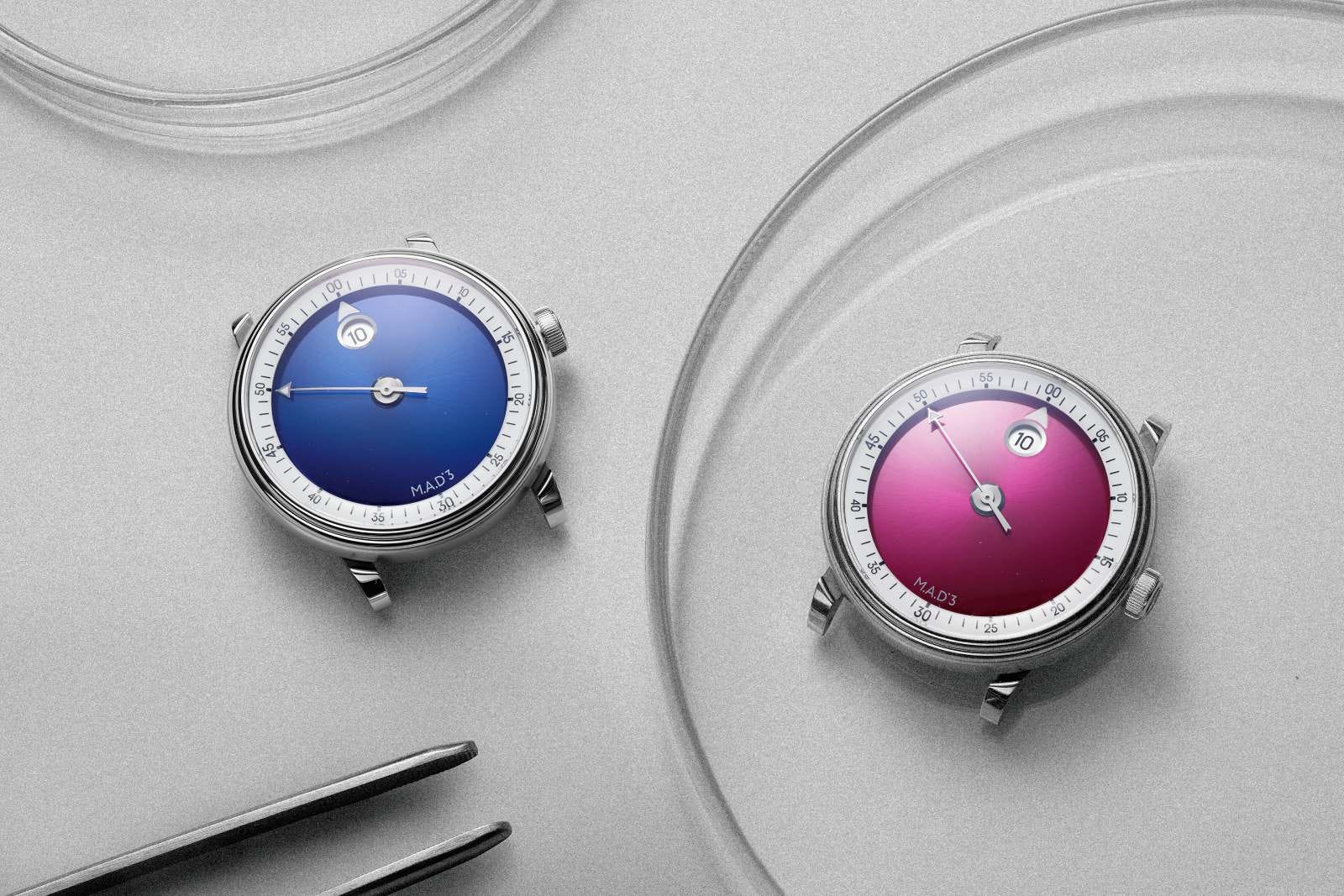
Every so often a watch lands that isn’t really about the watch at all — it’s about the person behind it. That’s the case with the M.A.D.3 Vincent Calabrese, the latest release from M.A.D.Editions, MB&F’s more attainable sister project. On the surface, it’s a steel, 40mm jumping-hour piece with a playful raspberry or cobalt dial. Underneath, it’s a tribute to one of independent watchmaking’s original agitators, and a genuinely clever reinterpretation of a complication he dreamed up nearly forty years ago. Collectors who care about where horology’s weirder, more inventive ideas actually come from should be paying attention.

Who Is Vincent Calabrese, Anyway?
If you don’t recognize the name, you’re not alone — and that’s rather the point. Vincent Calabrese has spent over five decades working just outside the spotlight, which is exactly where he seems to like it. Born in Naples and relocated to Switzerland as a teenager, he co-founded the Académie Horlogère des Créateurs Indépendants (AHCI) alongside Svend Andersen in 1985, building the institutional home for watchmaking’s independent thinkers. Along the way he designed the Golden Bridge movement that became a Corum signature, lent his mechanical imagination to Blancpain’s flying carrousel, and quietly amassed more than forty patents. He describes himself, in French, as “l’enquiquineur de l’horlogerie” — watchmaking’s troublemaker — for his habit of questioning why things are done the way they’ve always been done. At 82, he clearly hasn’t stopped asking.

The Baladin: A Wandering, Jumping Hour With a Point to Prove
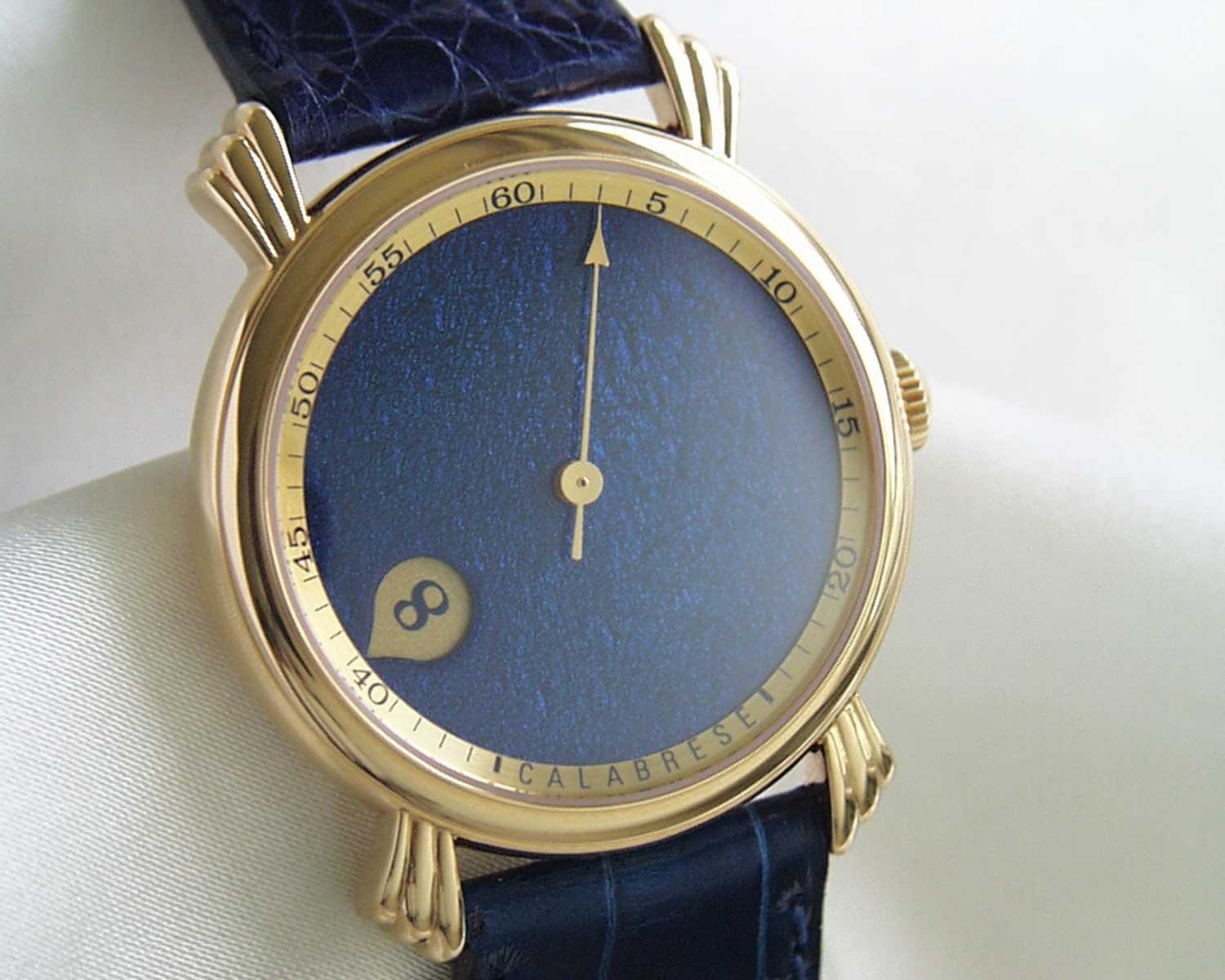
That question-everything instinct produced the Baladin, a watch Calabrese conceived in the late 1980s as his answer to a complication he found unsatisfying: the jumping hour. Traditional jump hours snap from one digit to the next with an abruptness Calabrese never much cared for, so instead he built something that moved — literally. The Baladin’s hour indication traveled around the dial rather than sitting fixed in a window, doing double duty as both hour marker and pointer as it journeyed across the surface. It was less a display than a small performance, produced in limited runs across different sizes and materials, and it remains one of the more poetic solutions the wandering-hours genre has ever seen.
Inside the M.A.D.3: The Specs That Matter
M.A.D.Editions doesn’t simply reissue the Baladin — it re-engineers it. The brand describes the M.A.D.3 as a complete rethinking of Calabrese’s wandering-hours module rather than a reproduction, built for a case meant to be worn daily rather than admired in a vitrine.
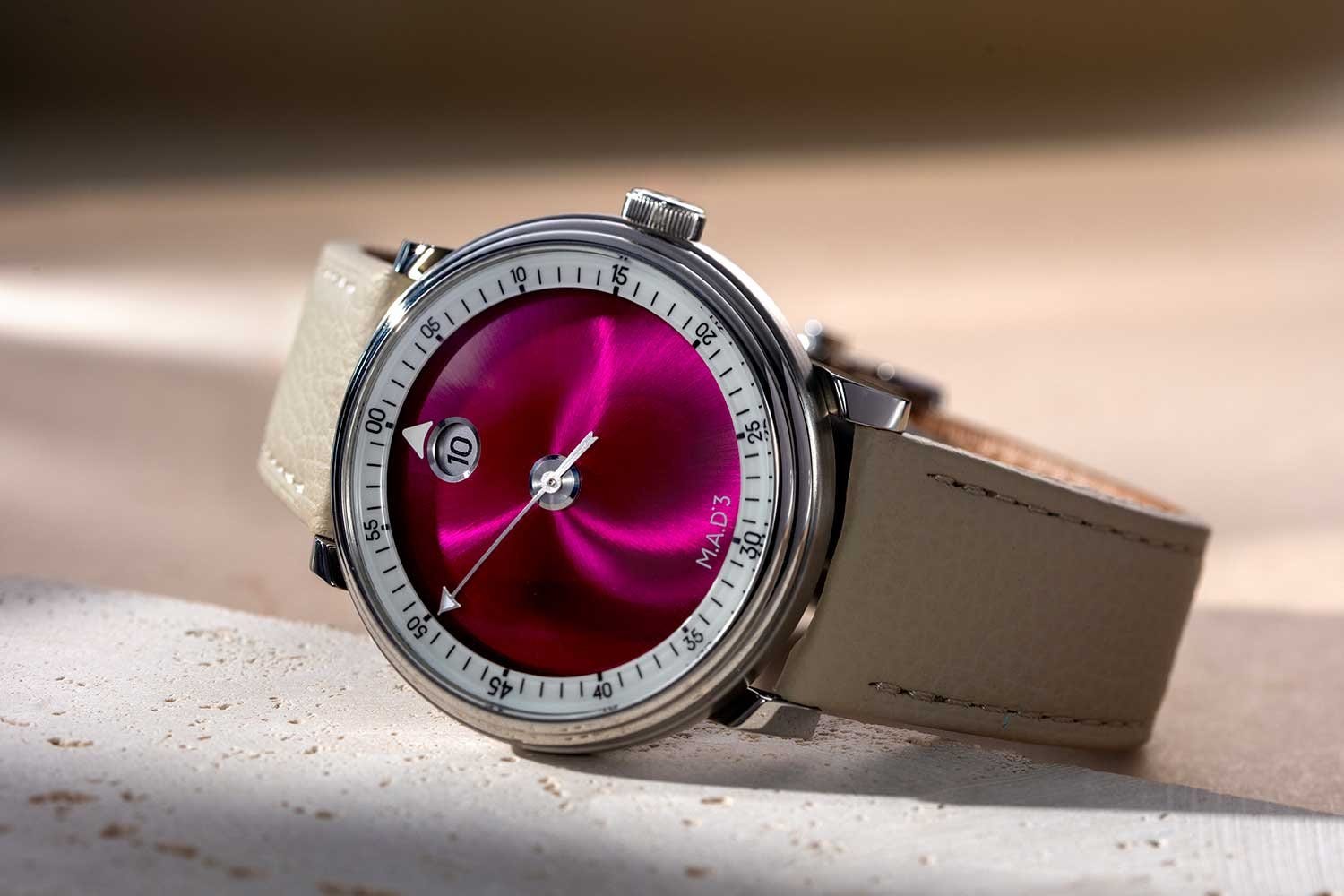
The 40mm x 12.7mm case, in 316L stainless steel with a 43.7mm lug-to-lug, was designed by Eric Giroud — the same hand behind the M.A.D.1 and M.A.D.2 — and features floating lugs, a double-step bezel, and domed sapphire crystals front and back, with 30 meters of water resistance. Inside beats a self-winding caliber built on the La Joux-Perret G111 base, fitted with MB&F’s own wandering-hour module, running at 28,800 vibrations per hour across 24 jewels with a 55-hour power reserve.
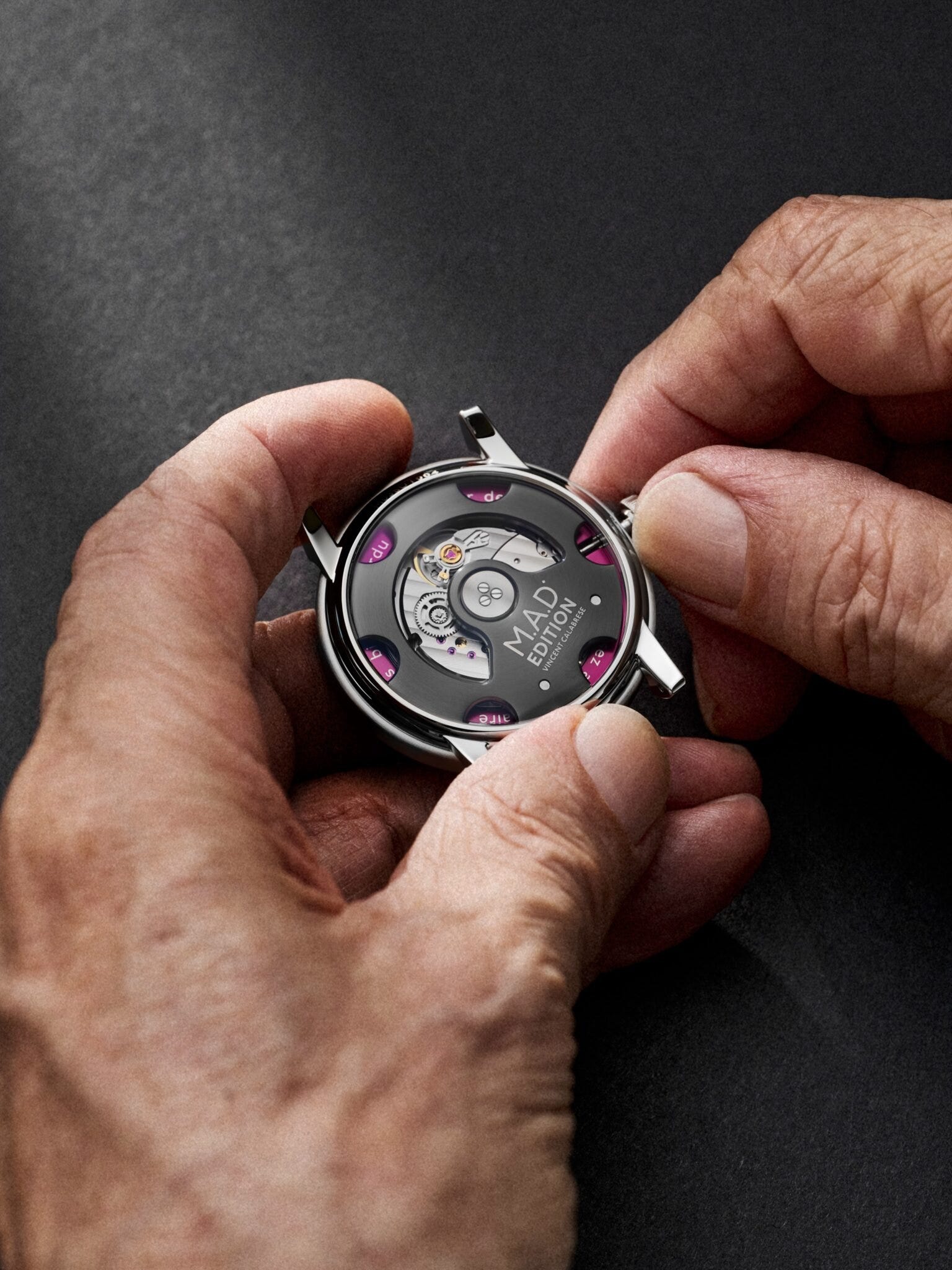
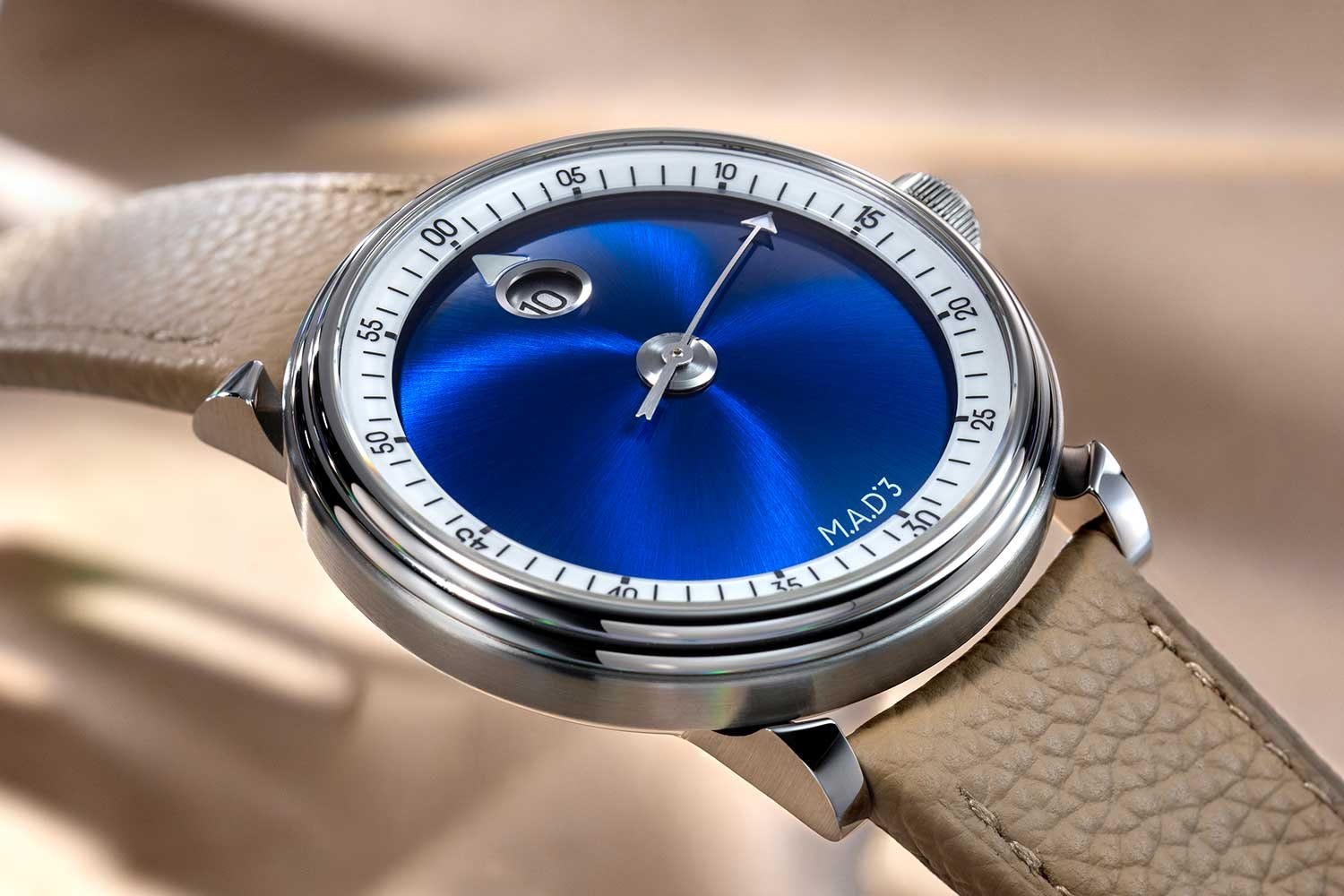
The dial is where the fun lives: a domed, sunray-brushed surface in either raspberry red or cobalt blue, a color that genuinely shifts character depending on the light hitting it. The jumping hour rides in its own aperture as it circles the dial, tracked by an arrow-tipped minute indicator against a luminous, bombé minute ring, with a central running-seconds hand keeping things honest. Flip it over and you’ll find a hidden inscription on the rotor: “It is fairly easy to please others, far more difficult to be proud of oneself” — a line that sounds exactly like something Calabrese would say himself. It ships on a leather strap with a stainless steel folding buckle.
As for getting one: the M.A.D.3 is priced at CHF 2,900 excluding taxes. The cobalt blue dial is allocated through M.A.D.Editions’ raffle system, while the raspberry version is reserved for the brand’s Tribe and Friends community — a distribution model that’s become something of a house signature.

Beyond the Wrist: What the M.A.D.3 Signals
M.A.D.Editions itself began as little more than a thank-you gesture — a side project Maximilian Büsser floated around 2014 and finally launched between 2020 and 2021 to give MB&F’s most loyal supporters something more accessible than the brand’s main collection. Handing that platform to Calabrese does two things at once: it puts real mechanical substance behind M.A.D.Editions’ growing catalogue, and it drags an important independent watchmaker’s ideas back into daylight for collectors who may never have heard his name. For an industry that talks endlessly about heritage while chasing hype, the M.A.D.3 is a reminder that some of the best ideas in modern watchmaking are decades old — they were just waiting for someone to take them seriously again.